
The Architecture of Torment: How Non-Euclidean Set Design Traps the Soul in Dark Cinema
The Dark Geometry of Cinematic Terror
In the most unsettling horror films, architecture does not merely contain the nightmare. It becomes the nightmare’s first living instrument. A corridor lengthens after the door closes, a staircase returns the traveler to the room already abandoned, or an apparently ordinary chamber reveals dimensions that no human body could comfortably inhabit. Such spaces turn geography into an antagonist. They do not chase the victim like a monster; they corrupt the rules by which escape, orientation, and safety are normally understood.
Human perception depends upon Euclidean expectations. Parallel lines should remain parallel, rooms should possess coherent interiors, and a route taken in one direction should eventually produce a recognizable destination. Symmetry, proportion, and repeated visual patterns allow the mind to construct a dependable map. Dark speculative cinema exploits that trust by introducing spatial dissonance, the sensation that a familiar environment is subtly but irreparably wrong. The result is primal dread: not simply fear of what waits in the dark, but terror that the dark has no stable dimensions at all.
German Expressionism and the Distorted Canvas of Caligari
The roots of psychological architecture reach back to silent cinema, when production design had to communicate interior states without synchronized dialogue or elaborate sound effects. German Expressionism recognized that painted scenery, exaggerated perspective, and violently artificial lighting could externalize madness more directly than realistic architecture. The street, staircase, and bedroom ceased to be neutral locations. Each became a visual symptom of anxiety, paranoia, or spiritual confinement.
The landmark whose twisted perspectives replaced naturalistic realism is The Cabinet of Dr. Caligari. Its tilted planes, jagged arches, narrow windows, and painted shadows refuse the reassuring logic of ordinary construction. Walls lean as though exhausted, streets converge at hostile angles, and shadows appear less like effects cast by objects than declarations of hidden intent. The setting mirrors the unstable consciousness of its world, making it difficult to separate external reality from delusion.
This was more than theatrical stylization transferred to film. In earlier stage traditions, scenery could suggest place, but Expressionist cinema made the entire image behave like a damaged mind. False shadows flattened depth while painted lines implied impossible recession. The viewer was forced to read architecture emotionally rather than architecturally. Later horror designers would build upon this principle, moving from flat canvases that represented insanity to fully dimensional environments that actively produce it. The hostile set was born when perspective stopped describing space and began to betray the people inside it.
Hellbound and the Cosmic Horrors of the Leviathan Labyrinth
Clive Barker’s vision of hell in Hellbound transforms that betrayal into an apparent cosmology. The labyrinth is not simply a dungeon with a maze-like arrangement. It is an endless system of thresholds, repetitions, chambers, and passages in which the distinction between destination and captivity has collapsed. The traveler may move forward, yet movement does not guarantee progress. Every corridor appears to promise revelation while preserving the deeper authority of the labyrinth.
At the center of this design logic stands Leviathan, represented by the immense black diamond whose geometry projects mathematical despair over the physical world. Its form suggests order, but not an order made for human comprehension. The shape is austere, symmetrical, and almost beautiful, yet its apparent perfection offers no comfort. Instead, it implies a governing intelligence so absolute that individual identity becomes a negligible measurement within an infinite diagram.
The visual power of the labyrinth depends on production design as much as mythology. Forced perspective can make a corridor appear longer or deeper than the constructed space permits. Rotating rooms can preserve a sense of continuous motion while concealing cuts or changing the viewer’s orientation. Liminal corridors, repeated architectural motifs, and severe contrasts between black surfaces and pale bodies make every threshold feel like a ritual rather than a practical passage.
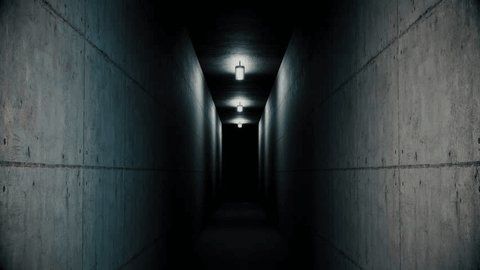
- Forced perspective compresses or expands apparent distance, turning scale into an unreliable promise.
- Rotating rooms allow gravity, direction, and continuity to shift without announcing the mechanism.
- Repeating corridors erase the distinction between return and advancement, creating captivity through visual sameness.
- Monolithic geometry gives the labyrinth an impersonal, cosmic authority rather than the personality of an ordinary villain.
The source material associated with Hellraiser should be treated carefully here. Production accounts and fan scholarship often describe the labyrinth through architectural and liminal language, but individual interpretations are not always confirmed canon. What remains unmistakable on screen is the design’s central function: hell is not merely a place where torment occurs. Hell is a structure that makes torment inescapable by denying the soul a stable position from which to understand its surroundings.
The Mechanics of Spatial Dissonance in Modern Production Design
Non-Euclidean horror becomes most effective when the trick is almost invisible. A room does not need to announce that its dimensions are impossible. It only needs to make the viewer feel that a door should lead somewhere else, that a ceiling is too far away, or that a familiar hallway has acquired a second, contradictory memory. Production designers work within the tension between beauty and violation. A set that looks entirely chaotic can become abstract, while a carefully composed set allows one impossible detail to contaminate the whole environment.
Classical architectural imagery has long explored this tension between order and impossible space. The visual manipulation of labyrinthine halls can feel especially close to historical experiments like Giovanni Battista Piranesi’s Carceri d’invenzione (Imaginary Prisons) series, represented in the Princeton University Art Museum collections. Such works demonstrate how repeated arches, converging lines, and framed openings can create an apparent depth that is visually persuasive even when the composition resists physical construction; the relevant object is documented by an Authoritative Source.
| Technique | Effect on the viewer | Psychological consequence |
|---|---|---|
| Forced perspective | Alters apparent scale and distance | Makes escape routes feel deceptive and unreliable |
| Impossible doorframes | Suggests incompatible rooms behind a single threshold | Turns every entrance into a decision with unknown consequences |
| Mismatched interiors | Allows an exterior and interior to contradict one another | Destroys the expectation that buildings possess stable boundaries |
| Rotating or reconfigured sets | Changes orientation while preserving visual continuity | Creates the sensation that gravity and memory are failing together |
Impossible doorframes are especially potent because doors traditionally mark controlled transitions. They separate public from private, safety from danger, and one narrative space from another. When a doorway appears too narrow for the room behind it, or when its frame does not align with the wall, the violation is immediate but difficult to articulate. The viewer registers a rule being broken before consciously identifying which rule it was.
Production designers also understand that horror requires contrast. Patricio M. Farrell’s reflections on horror design emphasize that a beautiful or apparently safe environment can make disturbing events more traumatic, while naturally eerie spaces need enough realism to avoid caricature. A carefully proportioned mansion, for example, can offer fluid movement and credible sightlines while still hiding a pattern of rooms that gradually becomes impossible. Beauty establishes trust; spatial betrayal weaponizes it.
Liminal Terrors and the Infinite Backrooms of the Mind
Contemporary digital horror extends these principles into spaces that can be generated, repeated, and altered with minimal physical limitation. The Backrooms image of endlessly changing yellow-walled offices, buzzing lights, stained carpet, and absent exits is frightening because it resembles a workplace designed for human circulation while removing every human purpose. The architecture is recognizable enough to invite navigation, yet empty enough to deny arrival. It is a building after meaning has been evacuated.
The mind rejects loops that return to themselves because navigation depends on difference. A landmark should confirm progress; a window should reveal a larger world; a corridor should connect distinct rooms. When every passage resembles the last, memory loses its authority. The traveler cannot determine whether the space has changed or whether perception has failed. Procedurally unnatural corridors intensify this crisis by producing near-repetition, not perfect repetition. Slight differences preserve hope while preventing certainty.
- Familiar materials, such as office carpet, plaster, fluorescent lighting, and institutional paint, make the impossible feel adjacent to everyday life.
- Empty infrastructure suggests that a human system once existed, but offers no evidence that human needs still matter.
- Acoustic repetition, including humming lights or distant mechanical noise, creates the sense of an environment that continues operating without inhabitants.
- Infinite extension converts ordinary inconvenience into metaphysical imprisonment.
This is where liminal horror approaches cosmic horror. The terror does not necessarily come from a visible creature. It comes from discovering that space can be built for humans while excluding human comfort, purpose, and return. The architecture becomes an existential argument: the universe may contain structures that resemble homes, workplaces, temples, or roads without being intended for human life. In that recognition, the soul is trapped before the body has even found a locked door.
Escaping the Infinite Architecture of Horror
Non-Euclidean set design functions as a psychological weapon because it attacks the mind’s basic contract with the world. Perspective promises measurable distance, thresholds promise transition, and rooms promise containment. Horror cinema breaks those promises one at a time. By making architecture contradictory, filmmakers externalize madness, desire, damnation, and cosmic indifference in forms the audience can physically feel.
The legacy of practical perspective trickery remains powerful even in an age of digital environments. Forced perspective, concealed joins, rotating rooms, repeated corridors, and carefully mismatched interiors possess a tactile authority that computer imagery does not automatically provide. They carry the evidence of material construction while presenting an impossibility. That contradiction is the heart of the spell. The viewer sees a real surface, a real shadow, and a real performer moving through a space that cannot logically exist.
For this reason, impossible geometry remains one of cinema’s most enduring metaphors for eternal damnation. Fire and chains describe pain, but a labyrinth describes the condition that makes pain permanent. There is no stable horizon, no reliable map, and no final door through which the soul can pass. In the darkest architecture, torment is not an event waiting inside the room. Torment is the room itself, and every attempt to escape only reveals another dimension of the design.